
Clark County Court Docket Searches
Start with Indiana MyCase, the main online door to a public Clark County court docket. It lists public, nonconfidential cases from courts on the Odyssey system. Pick “Clark County” to reach all six county trial courts. Choose “Clark County - Clarksville Town Court” only for matters filed in that town court. A statewide search is possible. But naming the court trims false matches. It also keeps the docket results readable.
Bring a full party name, business name, case number, citation number, or cross-reference number. The Attorney tab works when you know counsel. Name searches accept a date of birth, a sounds-like option, and open or closed filters. A case number is the strongest key. Names repeat. If the docket search stalls, ask the Clerk. The Clark County Clerk can check the official record and explain how to request a copy.
- Open MyCase and select the Case, Name, or Attorney tab.
- Choose Clark County or the separate Clarksville Town Court option.
- Enter the most exact identifier available and narrow by status or filing date.
- Open the result and confirm its court, parties, type, filed date, and status.
- Read the chronological case summary, then ask the Clerk for an official or certified copy when needed.
MyCase Fields for Clark Dockets
The Clark County court docket portal gives you more than one name box. Case, name, and attorney searches sit on separate forms. The court selector matters most. Clark County and Clarksville Town Court are distinct entries. Case status and filing-date limits help when a common name floods the results. MyCase caps a result set at 1,000 and makes you narrow anything larger.
| Search route | Useful fields | Best use |
|---|---|---|
| Case | Case, citation, or cross-reference number | Exact known matter |
| Name | Last, first, middle, business, birth date, sounds-like | Party lookup |
| Attorney | Name or bar number | Counsel-linked cases |
| Advanced | Open, closed, all; file date range | Narrowing results |
The Indiana MyCase help page states plainly that the online view is not the official court record. It frames what a Clark County docket search can and cannot do. The page also sends readers back to the clerk when an online document is missing.
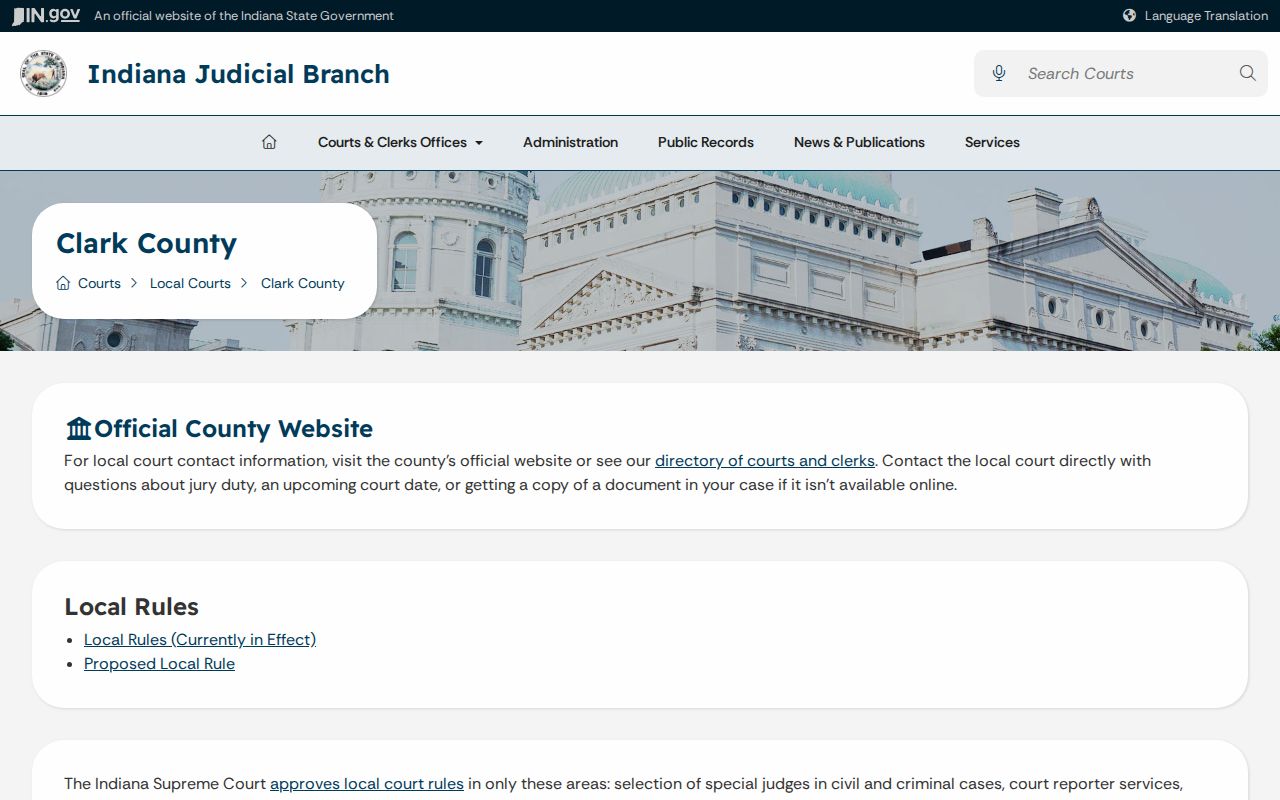
Treat any result as a locator. Verify key dates or orders with the court that entered them.
You can refine a result without starting over. Sort by court, case type, filed date, or status. That separates people who share a name. The list and table views show the same core identifiers in different forms. Open a case summary only after the caption and court match. There, read the most recent CCS events in context. One event label is not the outcome. An “appear by” date, for instance, may serve a purpose apart from a hearing session. The attorney tab helps when counsel is known. The business-name option keeps an organization out of first and last name fields. Those small choices cut the risk of following the wrong Clark County court docket.
Court Dockets: What They Show
A Clark County court docket names the case before it lists the events. MyCase results show the case number, style or caption, court, case type, filed date, and status. The summary can add party roles, attorneys, charges, bond information, and balances. Cross references, flags, and an appear-by date may appear where they apply. Its chronological case summary is the CCS. The CCS lists dated hearings, filings, orders, comments, judicial officers, and available attachments.
The CCS is an index and event history. It is not a copy of every document in the file. A line can show that a motion or order was filed without offering a download. Financial fields may give a current balance. A transaction summary may appear as well. Bond fields can show an amount and status in a criminal matter. Charges may carry the statute, offense date, degree, original offense, and citation reference. Public party details can be limited or redacted. When exact wording matters, note the event date. Then ask the Clark County Clerk for that document. That request beats asking for “everything.” It hands staff the court and record details they need to find the item.
| Case Number | An Odyssey identifier such as 10C01-YYMM-CT-#####, with county, court, time, type, and sequence segments. |
|---|---|
| Parties | Names and roles, plus counsel where public; removed-party and privacy limits may apply. |
| Docket Entries / Filings | Dated CCS events, motions, orders, comments, and some public attachments. |
| Hearing Settings | Sessions, setting type, date, time, judicial officer, and available location detail. |
| Court & Judge | The assigned Clark court and the officer tied to a hearing or entry. |
| Disposition | The recorded outcome of a charge, claim, or case, not merely a scheduled event. |
Clark Docket Codes Need Care
Clark County court docket numbers follow Indiana Administrative Rule 8 codes. The prefix 10 marks Clark County. A letter and digits after it identify the court. The rest of the number shows the filing year and month, case type, and sequential count. Keep every zero and hyphen when searching. A citation or UTT number differs from the Odyssey case number. It may belong in the traffic payment screen first.
One label conflict makes the court field critical. The Clark County Clerk calls all six county trial courts Circuit Court 1 through Circuit Court 6. Current MyCase results show Circuit Court 5 and 6. The state Odyssey conversion-history page, though, still labels codes 10D05 and 10D06 as Superior Court 5 and 6. That older label is not a second case. Match the code, the current court field, and the judge before concluding anything.
The Clerk’s courts page is the current local roster. Its listing helps resolve the court number behind a Clark County court docket. Phone details can differ from the state directory, so verify before calling.
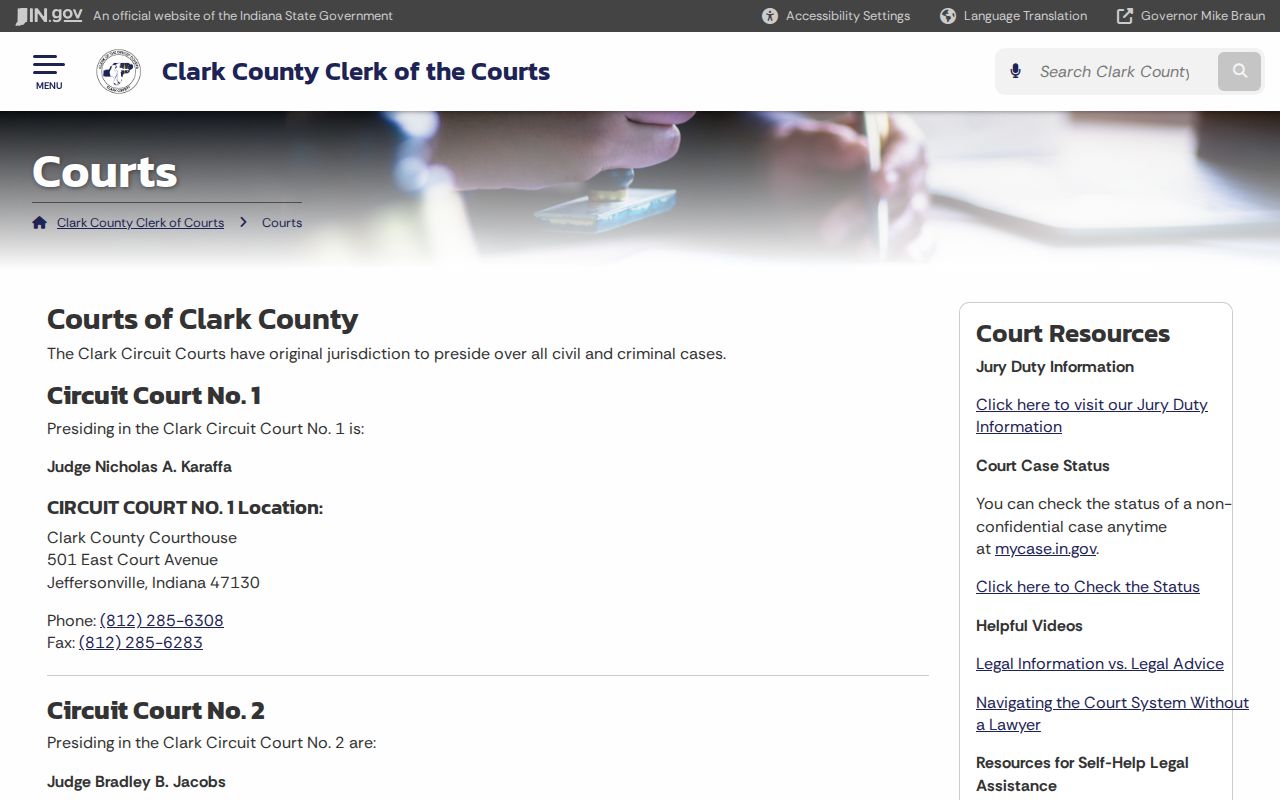
The roster pairs every numbered Clark County court with its sitting judge and public contact line.
One traffic or criminal matter can carry three different numbers. The local court number shows where the case sits. An Odyssey number marks the filed case and opens its CCS. A citation or UTT number marks the ticket itself and can lead to a payment screen. Related, yes. Interchangeable, no.
Say an ePay search returns your ticket. Copy the Odyssey case number from the detail view. Then run that number in MyCase to pull the fuller court record. MyCase may show a court label you did not expect. Compare the code. Do not hunt for a second file. That habit keeps the Clark County docket, the payment record, and the issuing ticket tied to one matter.
Clark County Courts and Dockets
Six Clark Circuit Courts split the county caseload under local allocation rules. Circuit 1 carries many major felony matters plus certain civil cases. Circuit 2 handles civil, family, estate, guardianship, and protection-order work. Circuit 3 mixes traffic-related criminal cases, civil matters, and problem-solving calendars. Circuit 4 holds civil and family assignments. Circuit 5 takes many misdemeanors, infractions, ordinance violations, and small claims. Circuit 6 covers felony, juvenile, family, and protection-order dockets. Transfers and reassignments happen. So the docket itself is the best source for the current court.
Clarksville Town Court sits apart from those six. Its public listing says it hears misdemeanor offenses arising in Clarksville. MyCase gives it a separate court selection. A search limited to the general Clark County option can miss a town-court result entirely.
Federal cases run on a different track. Clark County sits in the Southern District of Indiana. The New Albany Division is the usual federal trial venue. Those dockets live in PACER and federal CM/ECF, not MyCase. Appeals from Indiana trial courts move to the Indiana Court of Appeals. For the proper category, they go to the Indiana Supreme Court. Check the court named on the filing. That name tells you which system holds the docket.
| Court | Docket Covers | Where to Search |
|---|---|---|
| Clark Circuit Courts 1-6 | County criminal, civil, family, estate, juvenile, traffic, and other assigned cases | MyCase: Clark County; Clark County Clerk |
| Clarksville Town Court | Misdemeanors occurring in Clarksville | MyCase: Clark County - Clarksville Town Court |
| Indiana appellate courts | Appeals from trial-court decisions | Indiana appellate case search |
| Southern District of Indiana | Federal cases, usually New Albany Division for Clark County | PACER and federal CM/ECF |
Clark County Specialty Dockets
Some Clark County court dockets run on a program calendar alongside the standard case track. Local rules place Drug Treatment Court in Circuit 3 and Veterans Court in Circuit 4. Behavioral Health Court sits in Circuit 6. Family Treatment Drug Court also runs in Circuit 4. A participant's public case still carries its assigned Odyssey number. Program placement creates no free-standing public database.
Protection orders have their own statewide route through Indiana's protection-order portal. Guardian matters get a linked state public portal as well. Neither tool replaces MyCase for a full Clark County docket. Start with the kind of matter. Then pick the official system built for it. Confidentiality can still limit what a public user sees.
Filers working without a lawyer still need paperwork. They can pull it from the Clark County pro se forms page. The clerk's page also states plainly that staff cannot give legal advice.
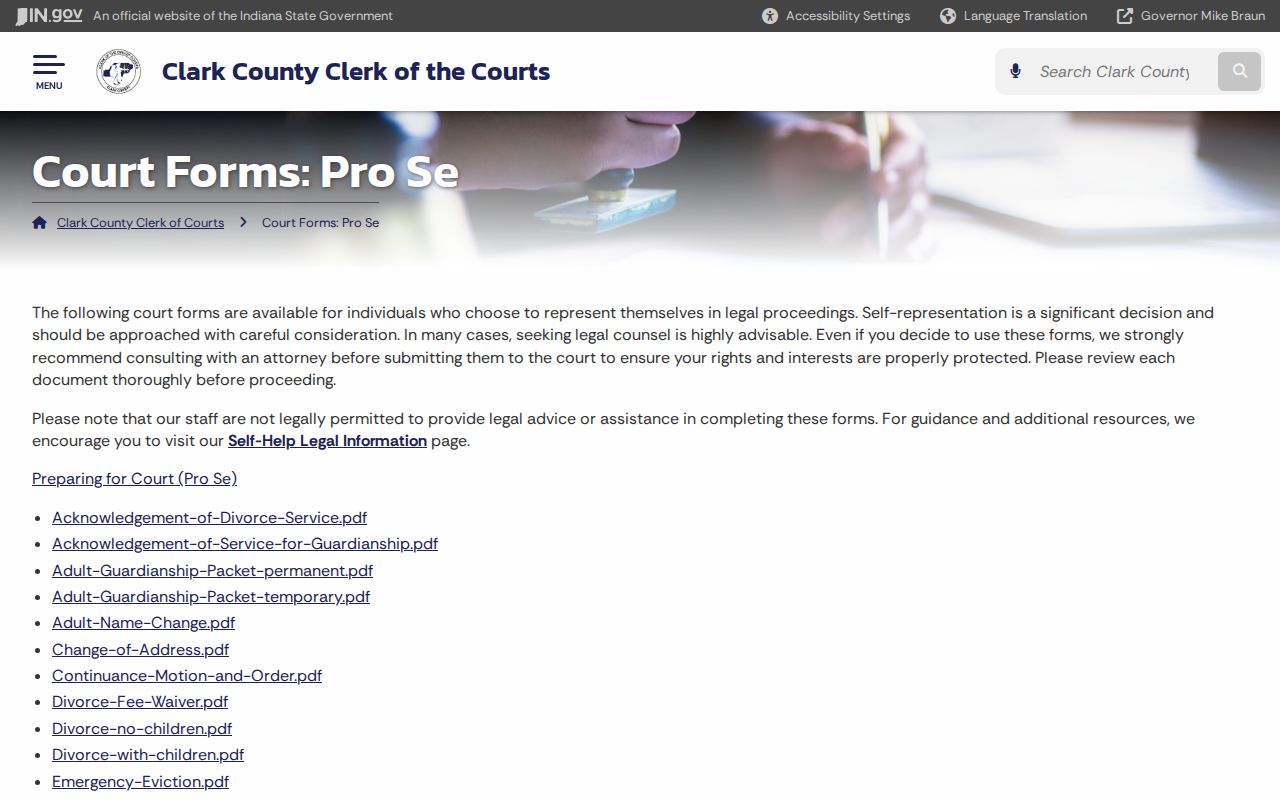
Forms get a matter filed. Case status and settings still live on the court docket.
Program dockets change how often a person appears and which team reviews the case. Public access rules still govern the underlying file. A program name on a calendar does not make every treatment detail public. Search by the assigned case number and read only what the public CCS presents.
For a protection order, the statewide protection-order search is the better first tool. It was built for those records. For guardianship, the linked state guardian portal is the tool where available. Confirm the official file through the clerk. Choosing the right channel beats typing the same name into every system.
Court Dates in Clark County
A Clark County court docket lists each scheduled session. It shows the date, time, judicial officer, and any comments filed with the event. Indiana Administrative Rule 9 sets the public daily-calendar fields too: case number, caption, case type, hearing time, and judge. Remember what a setting is. It marks a court date on the calendar, not proof that a trial happened. The later CCS entries tell the rest, showing a reset, continuance, cancellation, order, or final disposition.
Read the newest entry first. Check the prior setting too. A continuance moves a matter without ending it. A reset may add a new date on a later CCS line. Even a cancellation can be followed by another order. The case summary plus a call to the court gives a stronger check than any printed or downloaded list, which can go stale. When you call, give the case number and the assigned court before asking about the time. Staff can confirm what the record states. They cannot advise a party on seeking a delay or responding to an order. A missed setting carries real consequences. Contact the assigned Clark County court promptly rather than trusting the online list to be complete.
Use MyCase first. Then confirm the date with the assigned court or Clerk when timing matters. The county also posts a separate annual traffic-date PDF listing scheduled traffic sessions. That PDF is not a ticket search, and it may lag behind case-specific changes. The detailed Clark County court schedule shows how to compare that calendar against the live case summary.
For tickets, the Clerk traffic page links the official routes. There, court-date tasks and payment tasks sit apart from the general docket search.
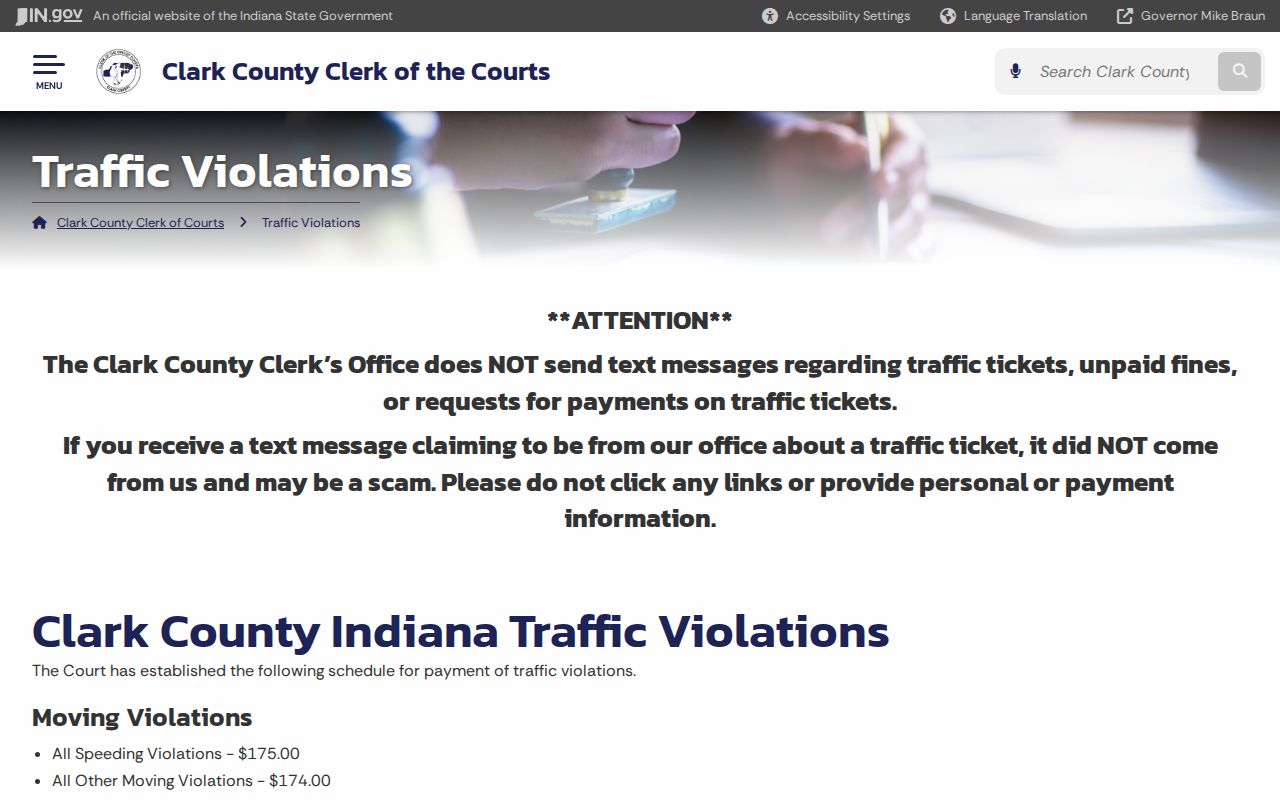
A ticket’s issuing court and UTT number should guide the next step.
Clark Docket Access Can Narrow
MyCase publishes public, nonconfidential information. That is its limit. Confidential cases and sealed records may be missing. The same goes for documents excluded from public access and attachments never posted online. Juvenile records, adoption matters, mental-health records, and parts of family cases can be restricted. Expunged criminal records fall under Indiana Code 35-38-9. So a missing result does not mean no court record exists.
Indiana's Access to Court Records Rule 5 lists categories excluded from public access. It also requires redaction of protected data. Rule 9 lets a court restrict access in extraordinary circumstances. That takes a verified request, notice, and findings. The Clerk cannot hand out a record a rule or court order closes. A person seeking their own restricted matter may need identification or a court-approved route.
Courthouse access and remote access are not the same thing. A public document can sit in the file even when MyCase offers no attachment. Ask for the specific record by case number, court, event date, and title. You may get a plain copy, a certified copy, an inspection appointment, or notice that the item is excluded. Certification is the clerk's attestation that a copy matches the official file. That is more than printing a public web page. A public-record request cannot cancel a sealing order. Access to a sealed item may take a motion. It may also take advice from a licensed attorney.
Search gap: Try the exact court and identifier, then ask the Clark County Clerk whether the case exists but is not available remotely.
Docket Access Under Indiana Law
Indiana Access to Court Records Rule 4 presumes court records are open. Another rule, statute, or order may exclude them. The Indiana court access rules govern these records. They do not treat each request as an ordinary agency request under the Access to Public Records Act. Remote access can be narrower than a visit to the clerk's office. Bulk data follows separate controls under Administrative Rule 9.
Key Rules:
Access Rule 4 states the general public-access presumption.
Access Rule 5 lists records excluded from public access and redaction duties.
Access Rule 9 covers case-specific requests to restrict otherwise public access.
Indiana Code 5-14-3 is the state Access to Public Records Act for agency records.
The Clark County bonds page shows how a public docket connects to a separate clerk process. Those official instructions cover bond steps, while the CCS remains the source for case events and bond status entries.
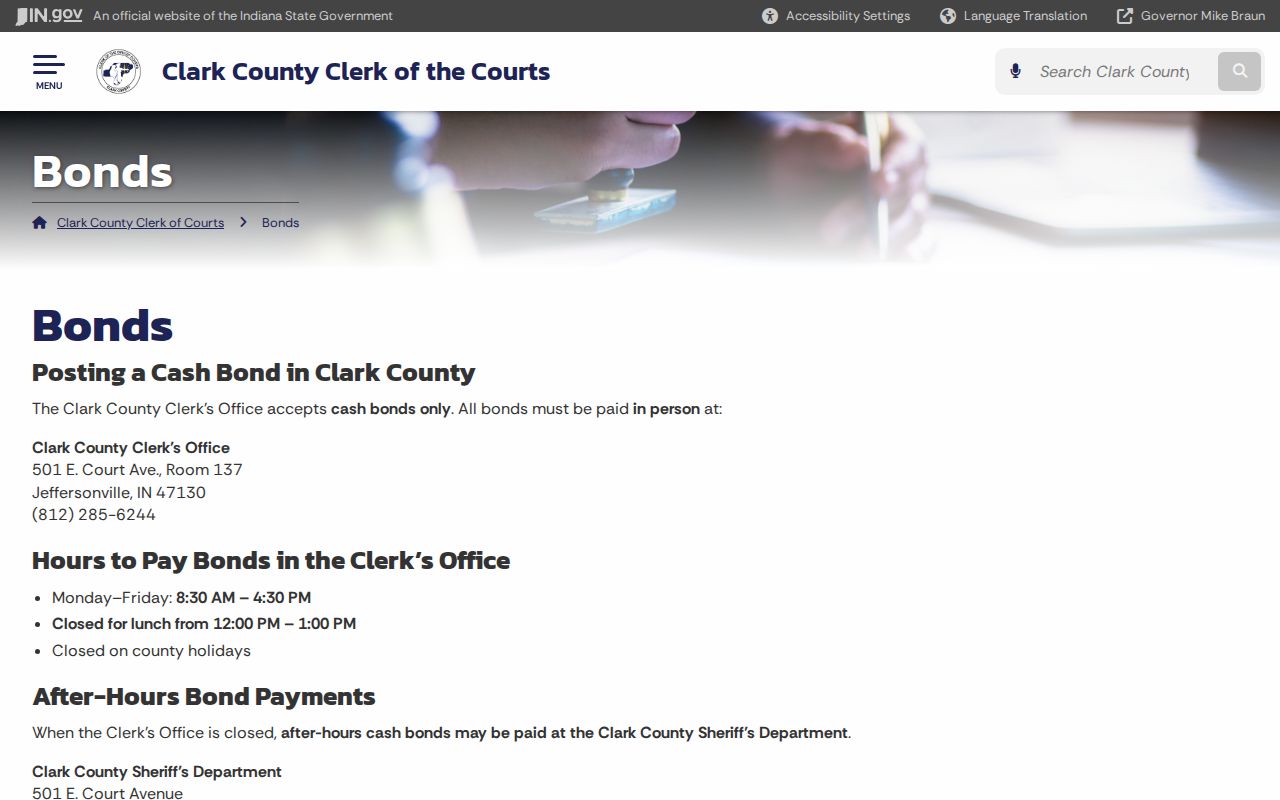
Always distinguish a clerk service page from the chronological case record.
Clark County Filing Costs
The Clerk publishes a filing-fee schedule covering new cases and added services. What you pay depends on case type, service method, and the number of defendants. No routine copy or certification price is set out there. So ask for that amount directly instead of treating a filing fee as a copy fee. Court costs can also appear in a case's financial section. That figure is not the charge for obtaining records.
The official filing fees and costs page is the current source for those charges. Check the live schedule before filing, since fees change and the posted figures control.
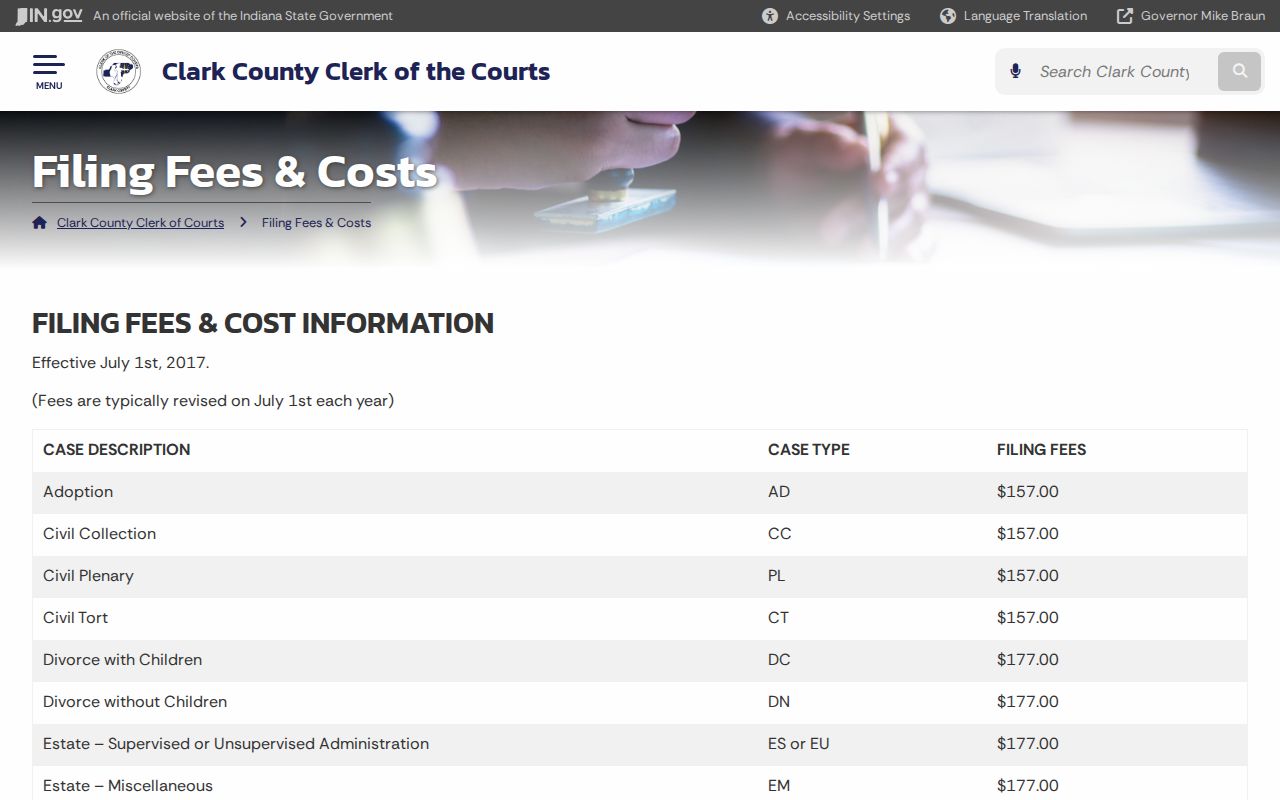
Ask the Clerk which fee line applies to your filing or service. Never infer a total from the docket balance alone.
How Clark’s Clerk Keeps Dockets
Clark County Clerk Ryan Lynch keeps the trial court docket for the county. His office holds official case documents, permanent historical records, and court revenues. A Clark County court record may not show online. In that case, write to the Clerk with the full case number, party names, court, and the exact document or date range you need. Staff can then explain in-person and other request routes. They can also cover identification rules and the cost of a plain or certified copy.
Start with the Clerk's main number for county case files. The six courts list separate public numbers for scheduling and courtroom questions. The Traffic Violations Bureau takes its own calls about tickets. The County Court Administrator handles administration, not records, so keep those roles straight. Mail a request to the Government Building. Include enough detail for staff to find the file. Hold off on payment until the Clerk confirms the amount and method. Never send cash. Hours change, so check them before visiting the courthouse.
The official Clerk home page gathers the court search, fees, forms, bonds, traffic matters, and court contacts in one spot. That page is the local entry point for Clark County docket work.
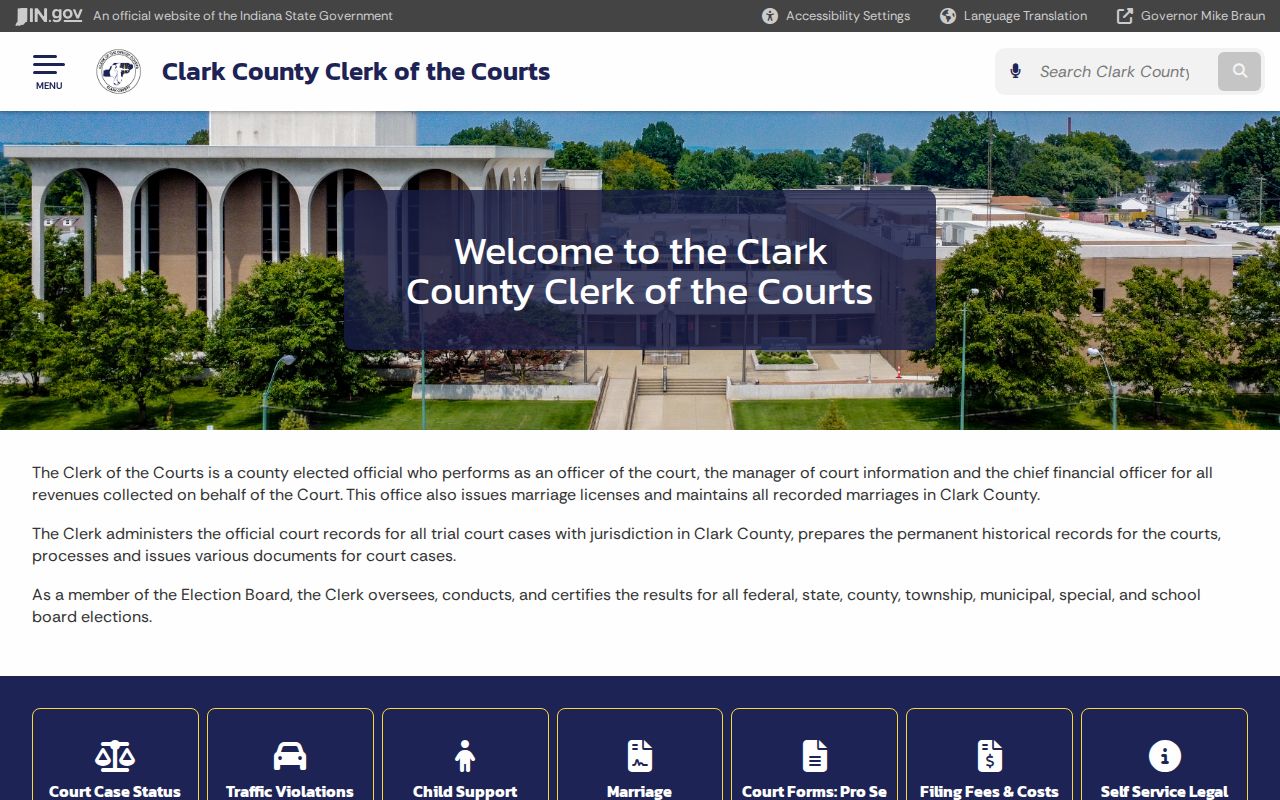
If a web docket leaves your record question open, use the Clerk's current contact details.
Clark County Docket Workload
Indiana's Court Statistics by County application offers scale without naming any party. Certified 2024 data puts 98,581 cases before all Clark courts in a single year. Within that total, 72,844 matters were already pending. Another 24,906 arrived as new filings, 22 were venued in, and 809 were transferred in. It is not a head count. It is not a count of convictions. It is also not what you will see in MyCase. One Clark County case can carry several parties, charges, hearings, and docket entries.
The four filing groups account for the reported total. Criminal filings include 2,889 misdemeanors and 2,875 miscellaneous criminal matters. Civil filings cover collections, torts, family matters, estates, guardianships, protective orders, and more. Civil violations add 7,404 infractions and 47 ordinance violations. Numbers like these explain a docket-search lesson. An exact case number plus a court filter matters. They say nothing about an outcome, and they never prove a given record is public.
For aggregate Clark County court statistics, ICOR is the right tool. MyCase is the right tool for public case lookup. Counting MyCase cards would miss confidential matters and run into its 1,000-result cap.
Clark County Docket History
Clark County's courts now run fully on Odyssey and MyCase. But the labels tell the story of that rollout. The Odyssey court-history table lists Clark Circuit Courts 1 through 4 as converting on October 13, 2008. Clarksville Town Court carries code 10I01 with a start of October 28, 2016. The table still uses older Superior Court labels for the two newest court codes. The Clerk and current case results, though, call them Circuit Courts 5 and 6.
Local-rule changes also shape where a docket begins. Indiana Supreme Court orders approved Clark allocation amendments in January and December 2025. The latter takes effect January 1, 2026. Those rules sort case types among the six courts. A case is not frozen in place, though, since transfer, recusal, and reassignment can all occur. The live docket's court field controls.
Courthouse history adds another layer for older Clark County records. Jeffersonville first became the county seat in 1802. The seat moved to Charlestown in 1812 and came back to Jeffersonville in 1878. Court and clerk operations now center on the Jeffersonville Government Building. Older documents may still carry Charlestown references. Read historical place names against the record date rather than inferring a current court. Permanent historical records stay part of the Clerk's job. So any genealogy or local-history request should state the period, names, and record type as clearly as possible.
The county courts and law resource page offers another official route into the local system. It reflects the county's wider set of court and law links for docket research.
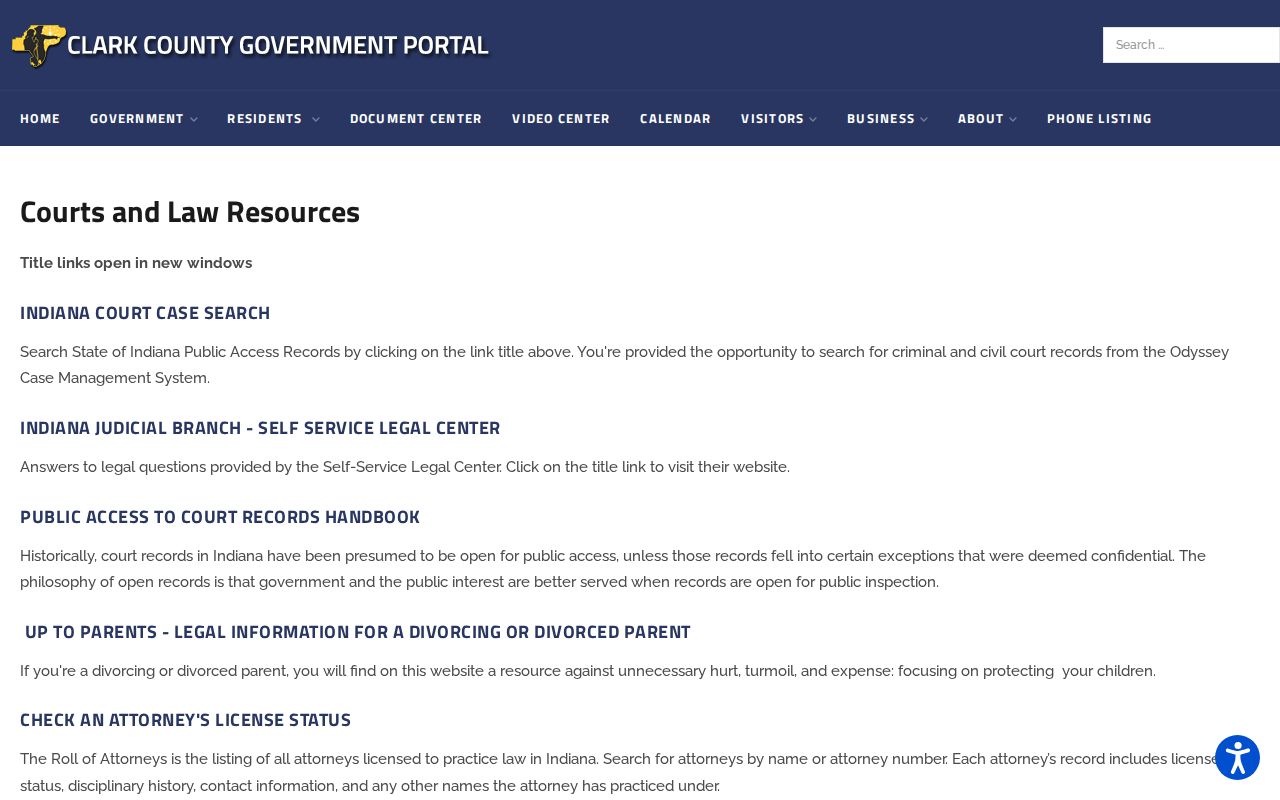
Orient with that directory, then lean on MyCase and the Clerk for the case itself.
City-by-City Dockets in Clark County
The five city pages sit in 2020 Census order of incorporated places. That ranking says nothing about courts, though. Clarksville alone has a separately listed current town court. Jeffersonville holds the county seat and the county courts. Yet the state directory shows no current separate city court there. Sellersburg, Charlestown, and Utica push their state cases into Clark County. Their municipal portals keep only local material such as ordinances and meeting records.
Jeffersonville splits the work in two. The City Clerk and Ordinance Violation Bureau take city matters. The county Clerk and Traffic Violations Bureau hold county court files and tickets. In Clarksville, the Town Court stands on its own. It has its own address, phone, court code, and MyCase selector entry. Sellersburg runs a virtual office with town financial and ordinance resources. But a payroll allowance docket is not a court CCS. Charlestown’s codified ordinances are legal texts, not case outcomes. Utica’s portal offers meetings and ordinance information without creating a new state court.
Let the notice guide you. Whatever court or agency printed on it is where the case lives. A state case tied to Sellersburg, Charlestown, or Utica goes to Clark County in MyCase. A Clarksville Town Court matter goes to that court by name. City ordinance or meeting records belong with the municipal clerk or portal. This split prevents a common mistake: reading any local document labeled “docket” as a chronological state court case summary. Population does not measure court volume either. The Census figures below set page order only, and Indiana’s ICOR system reports countywide court statistics across case categories.
Jeffersonville Court Records
49,447 · County seat and location of all six Clark Circuit Courts
Clarksville Court Records
22,333 · Separate Clarksville Town Court option in MyCase
Sellersburg Court Records
9,310 · State cases route to Clark County, not a Sellersburg court option
Charlestown Court Records
7,775 · City ordinance records are distinct from county case entries
Utica Court Records
860 · Town records stay local while state cases use Clark County
Jeffersonville's county-seat history explains a practical fact. Most Clark County court services sit there physically. A case may have arisen elsewhere in the county, and the services still cluster in Jeffersonville. The five city routes keep that distinction intact. Each city page opens with the local court or municipal record boundary. Then it points to the right county or state system for the rest.
If you are researching your own case, keep two facts together at all times. One is the court name. The other is the case number. Pair those on every Clark County docket search, because they route you far more reliably than a home address or a city label. A police agency standing alone will not do the work either.
Map and Directions to the Clark County Judicial Center
Clark Circuit Courts 1 through 6, the Clerk's Office, and traffic court all sit at the Clark County Judicial Center, 501 E Court Avenue, in downtown Jeffersonville; traffic court meets in Room 137, with sessions beginning at 8:30 a.m. Clarksville is the only Clark County municipality with its own separately listed court, the Clarksville Town Court at 2000 Broadway, which handles misdemeanor offenses occurring within the town.
Clark County Judicial Center
501 E Court Avenue
Jeffersonville, IN 47130
812-285-6244
Clarksville Town Court
2000 Broadway
Clarksville, IN 47129
812-283-1505
Monday-Friday, 8:30 a.m. to 4:30 p.m.
Public sources do not publish a routine building-hours, parking, or security-screening schedule for the Judicial Center, so calling the Clerk at 812-285-6244 or the assigned circuit court before a visit is the reliable way to confirm access.