
Clark County Criminal Docket Searches
Indiana MyCase is the main public route. Pick Clark County for Circuit Court cases. Choose Clark County - Clarksville Town Court only when a misdemeanor was assigned there. Searching All Odyssey Courts can pull false matches and bump against the portal's 1,000-result ceiling, so check the court label on each result card before trusting it. The label is part of the match. Search one identifier at a time. The Case tab takes a case number, citation number, or cross-reference number. No number in hand? The Name tab pairs a last name with first name, birth date, filing dates, status, and the Criminal & Citation category. For an old or missing record, call the Clark County Clerk at 812-285-6244, contact the assigned court, or ask about in-person access at 501 E Court Avenue.
- Choose Clark County or the separate Clarksville Town Court option.
- Enter one exact identifier, or use a narrow name and date search.
- Match the court, case type, filed date, and status.
- Open the Chronological Case Summary and read events in date order.
- Ask the clerk for a complete or certified record when needed.
Clark Criminal Cases Split Six Ways
Clark County's current allocation order splits criminal work six ways, by offense type and place. Major felony and firearm matters alternate between Circuit Courts 1 and 4. Controlled-substance felonies land in Circuit 2. Level 6 and former Class D felony matters go to Circuit 3. Traffic-related criminal cases go there too. Non-Clarksville misdemeanors belong to Circuit 5. Clarksville is the exception. Misdemeanors committed there are heard by Clarksville Town Court, listed separately in MyCase, and juvenile criminal matters go to Circuit 4 with limited public access. Assignment follows the local order, never a guess based on a party's address. The Clerk's courts list names all six county courts with their contacts.
Criminal Dockets: What They Show
A public MyCase summary opens with the case style, number, court and code. It also lists category, type, filed date, status date, and active flag. Criminal sections add detail. They may list charge number, citation number, offense date, statute, degree, and original offense. The CCS goes further. It records hearings, filed documents, judicial officers, comments, cancellations, dispositions, sentencing data, and public financial events.
| Case number | A four-part Indiana identifier covering court, year/month, type, and sequence, such as court-year/month-type-sequence. |
|---|---|
| Charge | An allegation with an offense description, statute, degree, and possible later modification. |
| Setting | A scheduled arraignment, conference, hearing, trial, or review that may later move. |
| Document | A filing linked to an event when remote public access is allowed. |
| Disposition | The recorded result for a charge or case, with sentencing fields when applicable. |
Clark Charges Need Later Entries
That charge label on a result card is not the last word. It captures an allegation at a single point in the case. Later Clark County criminal docket entries may amend the offense, dismiss a count, record a plea, merge counts, enter judgment, or impose a sentence. Read the full chronology plus any public order before calling an outcome. The Indiana public-access materials explain why an online header can stay visible while an attached document does not. That official resource page stresses the same lesson. A public index entry and the underlying court document are two different things.
Read the event date, description, charge number, and judicial officer together. If the outcome truly matters, get the judgment or sentencing order from the clerk. A short result label will not carry that weight.
Criminal Case Stages on the Docket
No Clark County criminal case follows one rigid path. Yet the CCS records each procedural turn. Filing opens the cause. The initial appearance or arraignment marks the first court event. Pretrial settings bring motions, discovery-related entries, continuances, plea filings, or trial settings. A plea or trial can lead to judgment, followed by sentencing and financial entries.
Docket flow: Filing › Arraignment › Pretrial › Plea or Trial › Disposition › Sentencing
A setting is not a disposition. A continuance is not a dismissal. And an active flag is just a system status, never proof of guilt. Confirm future dates with the assigned Clark court, since hearing data can change after it first posts online.
Clark Bond Data Is Not Outcome
Bond is a condition of release and appearance, not a finding on a charge. Clark's official bonds page notes that the Clerk accepts cash bonds only. The page also says a $5 Special Death Benefit Fund amount is usually added. Have the case number ready when you call. Refunds require the proper release condition or order, the named recipient's information, an affidavit, and photo identification. Indiana's public-records page points people toward official court sources. It does not treat an online bond field as the full record.
Bond money may later cover costs, fines, fees, or restitution. It can also be forfeited. Either way, no single entry states the final disposition.
Clark County Criminal Docket Courts
Every Clark County felony docket runs through one building. All six Clark Circuit Courts sit at 501 E Court Avenue in Jeffersonville. Call the assigned court directly about a setting or a judge. Circuit 1 answers at 812-285-6308 or 6309. Circuit 2 answers at 812-285-6333, and Circuit 3 at 812-285-6316. Circuit 4 can be reached at 812-285-6294. Circuit 5 sits at 812-670-4949, and Circuit 6 at 812-670-4950. The official listings for Circuit 1 conflict, so confirm that number before relying on it.
Clarksville Town Court handles its own docket at 2000 Broadway, Clarksville, phone 812-283-1505. Its Odyssey code is 10I01. Codes matter here. The state Odyssey history still labels some codes with older Superior Court names, even though those codes now belong to Circuit Courts 5 and 6. Both the Clerk and live MyCase call them Circuit Court. When a label looks stale, the court code is often the steadier clue for tracking a Clark County case.
Clark Judgment and Sentence Records
A judgment or sentencing entry shows up in the CCS after the plea or trial. Scan for a disposition type. Note the charge it covers, and any link to the judgment or sentencing document itself. The sentencing fields may list confinement terms and jail credit. They may also include suspended time, conditions, fees, and comments. Not every field appears in each Clark County criminal docket.
The Indiana request guide points requesters to one office. That is the clerk of the court that heard the matter. The official page also outlines what the clerk expects in a request.
Include the full case number, the court, the party name, the document title, and a date range. Ask about plain versus certified copies, current fees, and delivery options. The Clark Clerk sets fees per request, so no flat copy fee applies to every order.
Clark Criminal Attachments Have Limits
A public case header does not open every attachment. Indiana Access to Court Records Rule 5 keeps certain material out of public view. That includes medical and treatment records. It also covers protected victim or witness information, ex parte material, pretrial supervision records, and some problem-solving court supervision files. An event can stay visible on the docket even when its PDF is restricted. The same is true when the PDF was never digitized at all.
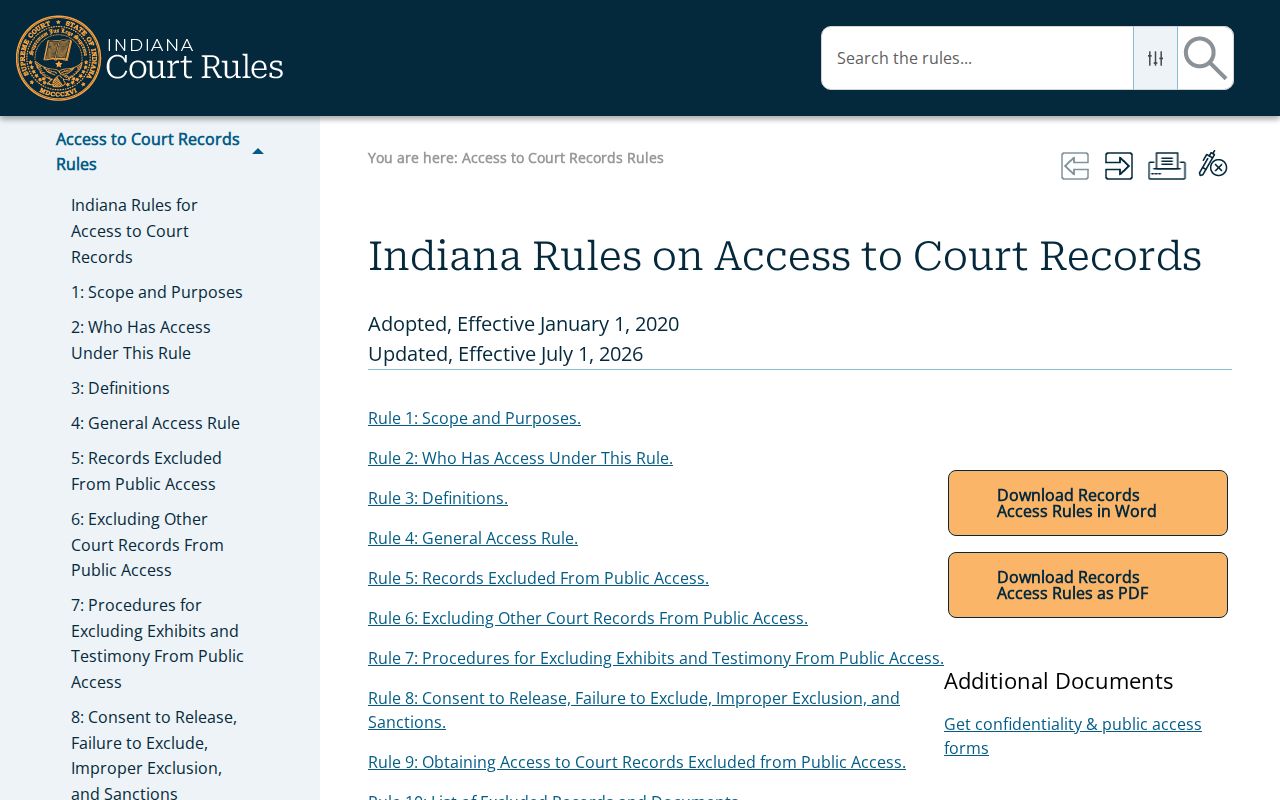
The Indiana court-record rules landing page carries the current rule set. Anyone working through a Clark County criminal docket can read the exclusions there in full.
A missing download icon does not mean a record never existed. Ask the Clark Clerk what happened to it. The document may be restricted, sealed, expunged, not digitized, or available only through another approved channel.
Access Rules for Criminal Dockets
Indiana Access to Court Records Rule 4 starts from a simple premise. Court records are public by default. Rule 5 or another authority can exclude them. That baseline covers paper, electronic, audio, video, and other formats. It does not, however, promise remote access to every field. MyCase itself posts a warning. Its information is not the official court record, and it may be incomplete.
The official Rule 4 page states the public-access rule in full. It is the baseline that governs Clark County criminal court dockets.
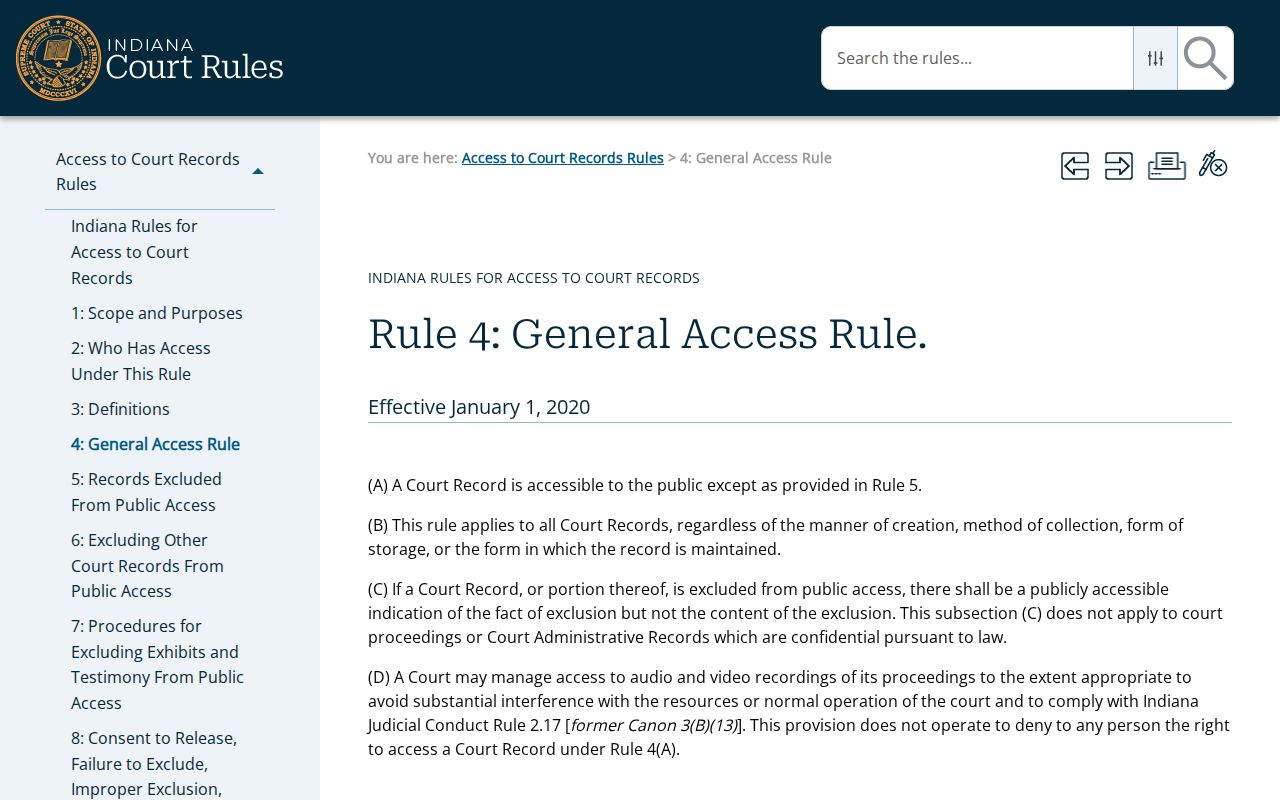
Key rules: Rule 4 sets the public presumption. Rule 5 lists confidential cases, excluded records, and required redactions. Rule 9 governs verified requests for access in limited extraordinary circumstances.
Sealed, confidential, juvenile, and expunged matters may be missing from a docket or sharply limited. The clerk can walk you through procedure, but cannot share protected facts or hand out legal advice.